'%3e%3cpath%20d='M21.0949%203.79395L13.9961%209.82854H21.0949V3.79395Z'%20stroke='black'%20stroke-width='1.38'%20stroke-miterlimit='10'/%3e%3cpath%20d='M13.998%209.82854L7.44531%203.79395V9.82854H13.998Z'%20stroke='black'%20stroke-width='1.38'%20stroke-miterlimit='10'/%3e%3cpath%20d='M13.9961%202.69922V25.1919'%20stroke='black'%20stroke-width='1.38'%20stroke-miterlimit='10'/%3e%3cpath%20d='M20.5488%2016.4113L13.9961%209.82812V18.2217L20.5488%2024.0918V16.4113Z'%20stroke='black'%20stroke-width='1.38'%20stroke-miterlimit='10'/%3e%3cpath%20d='M7.44531%2016.4113L13.998%209.82812V18.0526L7.44531%2024.0918V16.4113Z'%20stroke='black'%20stroke-width='1.38'%20stroke-miterlimit='10'/%3e%3cpath%20d='M4.71094%209.82812V18.6057H7.44125V16.4113L13.9941%209.82812H4.71094Z'%20stroke='black'%20stroke-width='1.38'%20stroke-miterlimit='10'/%3e%3cpath%20d='M13.9961%209.82812L20.5488%2016.4113V18.6057H23.2792V9.82812H13.9961Z'%20stroke='black'%20stroke-width='1.38'%20stroke-miterlimit='10'/%3e%3c/g%3e%3c/svg%3e)

'%3e%3cmask%20id='mask0_21456_29260'%20style='mask-type:luminance'%20maskUnits='userSpaceOnUse'%20x='0'%20y='0'%20width='28'%20height='28'%3e%3cpath%20d='M27.5%200.5H0.5V27.5H27.5V0.5Z'%20fill='white'/%3e%3c/mask%3e%3cg%20mask='url(%23mask0_21456_29260)'%3e%3cpath%20d='M14%2027.5C13.4854%2024.1035%2011.8974%2020.9608%209.46828%2018.5317C7.03922%2016.1026%203.89651%2014.5146%200.5%2014C3.89651%2013.4854%207.03922%2011.8974%209.46828%209.46828C11.8974%207.03922%2013.4854%203.89651%2014%200.5C14.5147%203.89644%2016.1028%207.03905%2018.5318%209.46816C20.9609%2011.8972%2024.1035%2013.4853%2027.5%2014C24.1035%2014.5147%2020.9609%2016.1028%2018.5318%2018.5318C16.1028%2020.9609%2014.5147%2024.1035%2014%2027.5Z'%20fill='url(%23paint0_linear_21456_29260)'/%3e%3c/g%3e%3c/g%3e%3cdefs%3e%3clinearGradient%20id='paint0_linear_21456_29260'%20x1='9.5'%20y1='9.5'%20x2='20.75'%20y2='21.875'%20gradientUnits='userSpaceOnUse'%3e%3cstop%20stop-color='%23F0DCD6'/%3e%3cstop%20offset='0.914506'%20stop-color='%231D6DFF'/%3e%3c/linearGradient%3e%3cclipPath%20id='clip0_21456_29260'%3e%3crect%20width='28'%20height='28'%20fill='white'/%3e%3c/clipPath%3e%3c/defs%3e%3c/svg%3e)
'%3e%3cpath%20d='M22.8019%2011.2412L23.5234%2011.6807V12.0103L23.3172%2012.7796L14.5579%2014.9771L13.7344%2012.7951L22.8019%2011.2412Z'%20fill='%23D97757'/%3e%3cpath%20d='M19.5236%204.77832L20.5322%205.00396L20.8%205.35575L21.0552%206.19876L20.9494%206.73644L15.0712%2015.3068L13.1133%2013.2191L18.5338%205.63471L19.5236%204.77832Z'%20fill='%23D97757'/%3e%3cpath%20d='M14.4577%203.43951L15.0761%203L15.5912%203.21976L16.1065%203.9889L14.6949%2013.0345L13.7364%2012.3397L13.3242%2011.131L14.0456%204.31853L14.4577%203.43951Z'%20fill='%23D97757'/%3e%3cpath%20d='M7.84766%203.5851L8.48285%202.7199L8.89716%202.61914L9.71923%202.74717L10.125%203.08581L13.0815%2010.0748L14.1509%2013.3954L12.8997%2014.1372L8.13117%204.91019L7.84766%203.5851Z'%20fill='%23D97757'/%3e%3cpath%20d='M4.77232%208.38688L4.56641%207.50742L5.18478%206.73828L5.90613%206.84816H6.11223L10.4403%2010.2544L11.78%2011.3531L13.6349%2012.8914L12.6044%2014.7594L11.6769%2013.9903L11.0586%2013.331L5.08168%208.82593L4.77232%208.38688Z'%20fill='%23D97757'/%3e%3cpath%20d='M3.53288%2014.0982L3.06641%2013.5489L3.06647%2013.0601L3.53288%2012.8896L8.78833%2013.2193L13.9408%2013.6588L13.7736%2014.7528L3.94502%2014.2082L3.53288%2014.0982Z'%20fill='%23D97757'/%3e%3cpath%20d='M6.62378%2019.8178H5.59334L5.18359%2019.3146V18.7132L6.93299%2017.3946L14.045%2012.5674L14.7648%2013.8785L6.62378%2019.8178Z'%20fill='%23D97757'/%3e%3cpath%20d='M8.57739%2022.8884L8.16518%2022.9984L7.54688%2022.6687L7.64995%2022.1193L13.7299%2013.5488L14.5543%2014.7574L10.0201%2021.1305L8.57739%2022.8884Z'%20fill='%23D97757'/%3e%3cpath%20d='M13.7361%2023.9861L13.4271%2024.4257L12.8088%2024.6454L12.2935%2024.2058L11.9844%2023.5466L13.5301%2014.6465L14.4576%2014.7563L13.7361%2023.9861Z'%20fill='%23D97757'/%3e%3cpath%20d='M18.9869%2021.5713V22.4503L18.8838%2022.7799L18.4716%2022.9997L17.7503%2022.8974L12.7969%2015.0367L14.7617%2013.4404L16.4104%2016.6269L16.5652%2017.7805L18.9869%2021.5713Z'%20fill='%23D97757'/%3e%3cpath%20d='M21.3629%2020.2507L21.4659%2020.8L21.1568%2021.2396L20.8476%2021.1297L19.0958%2019.8112L16.4165%2017.284L14.3555%2015.7457L14.9736%2013.6582L16.0041%2014.3175L16.6226%2015.5259L21.3629%2020.2507Z'%20fill='%23D97757'/%3e%3cpath%20d='M20.0232%2014.6482L22.5995%2014.8679L23.2178%2015.3074L23.6299%2015.9667V16.441L22.4964%2016.9556L16.7256%2015.4173L14.3555%2015.3074L14.9737%2013L16.6226%2014.3185L20.0232%2014.6482Z'%20fill='%23D97757'/%3e%3c/g%3e%3c/svg%3e)
Key Takeaways
- Five core types of AI agents shape most textbooks and product designs: simple reflex, model-based reflex, goal-based, utility-based, and learning agents. Hierarchical agents and multi-agent systems extend those patterns for larger workflows.
- In 2026, teams use agents to automate multi-step work, handle support queues, assist individuals, feed decision systems, and localize video for other languages.
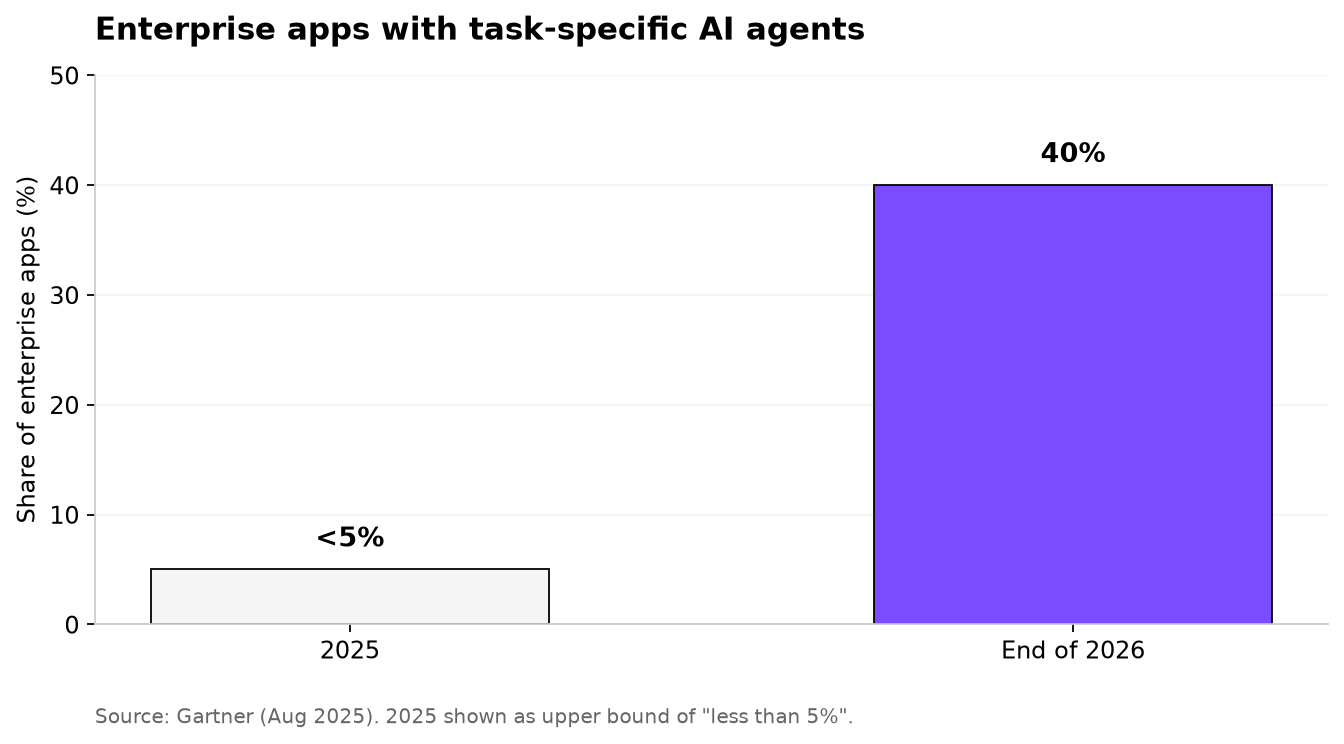
- Gartner expects task-specific AI agents inside 40% of enterprise applications by the end of 2026, up from under 5% in 2025. That forecast points to specialized agents, such as video localization, gaining product seats faster than generic "do everything" bots.
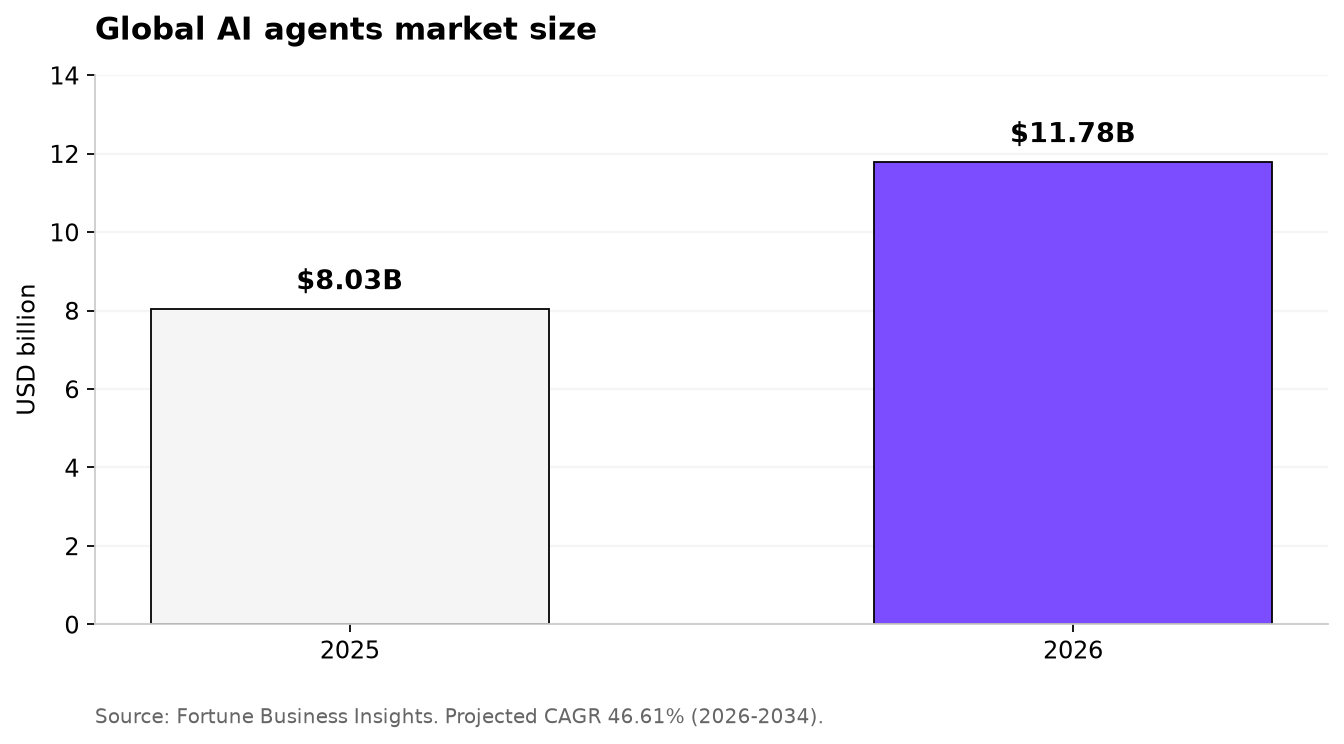
- Fortune Business Insights valued the global AI agents market at USD 8.03 billion in 2025 and projects USD 11.78 billion in 2026 (46.61% CAGR through 2034). Growth concentrates where agents finish bounded jobs with measurable output.
- Design trade-offs still matter: privacy, accuracy, review loops, edge cases, and engineering cost. Pick the agent type that matches observability, goals, and risk, then add human review where errors cost more than delay.
Teams ship more agent features in 2026 than in prior years. The label "AI agent" still covers very different designs. This guide maps the five classic types, related architectures, how agents run in practice, and where a video localization agent fits.
What an AI agent does
An AI agent takes goals or tasks from people, reads inputs from its environment, chooses actions with models and tools, and works toward those goals with limited supervision. Autonomy varies: some agents only fire fixed rules; others plan, call tools, and update behavior from feedback.
Core components
Most agent stacks share a perception -> decision -> action loop. Many production systems also add learning, planning, memory, and communication.
Perception
The agent turns sensors, APIs, files, or user text into structured state. A chatbot reads a message. A warehouse robot reads camera and lidar frames. Clean perception reduces bad decisions later.
Decision / reasoning
Rules, planners, reinforcement learning, or large language models score options against the current state and goals. Complexity scales with task length and uncertainty.
Action
The agent writes to systems, moves hardware, or replies to users. A trading agent submits an order. A localization agent exports dubbed video and subtitle files.
Learning (when present)
Feedback updates policy or model weights. Teams use supervised data, unsupervised structure discovery, reinforcement signals, or online updates.
Planning, memory, and communication
Planning breaks a goal into steps. Short-term memory holds the current session; long-term memory holds policies, glossaries, or knowledge bases. Communication lets agents talk to users, tools, or other agents.
AI agents vs AI assistants vs bots
All three automate work. They differ in autonomy and planning depth.
| Feature | AI agent | AI assistant | Bot |
|---|---|---|---|
| Role | Plans, decides, and executes toward a goal | Helps through conversation or commands | Reacts to fixed inputs |
| Autonomy | High | Moderate | Very low |
| Decision style | Goal-driven planning | Light reasoning with models | Scripts or menus |
| Interaction | Can run with little user input | Conversational | Command or menu driven |
| Learning | Often adapts strategy | Often uses ML models | Little or none |
| Task shape | Multi-step workflows | Multi-step work with guidance | Short, repetitive replies |
| Example | Research market data, draft a report, send it | Set a reminder for 9 AM tomorrow | Reply with store hours |
Real-world examples
- Vehicles and drones: detect objects, plan paths, control motion.
- Research agents: search, summarize, and draft reports with light supervision.
- Smart home agents: adjust lights and climate from schedules and sensors.
- Warehouse robots: move stock, sort packages, coordinate routes.
- Personal task agents: schedule meetings and triage email.
- Video localization agents: transcribe, translate, dub, subtitle, and sync lips for other languages. See how AI agents work in localization for a practical walkthrough.
Why agent types matter
Matching type to task cuts redesign later. Reflex agents fit fully observed, rule-heavy settings. Goal and utility agents fit trade-offs and planning. Learning agents fit noisy environments with feedback. Wrong type usually shows up as brittle rules, slow planning, or uncontrolled cost.
Five core types of AI agents
1. Simple reflex agents
A simple reflex agent maps the current percept to an action with condition-action rules. It stores no history.
- Best fit: fully observable environments with stable rules
- Example: a thermostat that starts heat when temperature falls below a threshold
- Limits: novel situations outside the rule table produce errors; no learning from past runs
2. Model-based reflex agents
A model-based reflex agent keeps an internal state that tracks parts of the world it cannot see right now. It updates that state as new percepts arrive, then applies rules on the combined view.
- Best fit: partially observable settings
- Example: a robot vacuum that marks cleaned zones and skips them later
- Strength: reasons about hidden state without full goal search
3. Goal-based agents
A goal-based agent scores actions by how they move the system toward an explicit goal. Search and planning choose among sequences of steps.
- Example: a navigation system that finds a route to a destination
- Strength: more flexible than reflex rules when several paths reach the same goal
4. Utility-based agents
A utility-based agent ranks outcomes with a utility function when several goals or costs compete. It picks the action with the best expected utility under uncertainty.
- Example: a ride-hailing matcher that balances trip time, fuel or battery cost, and driver supply
- Strength: handles trade-offs that a single binary goal cannot express
5. Learning agents
A learning agent improves from experience. Classic designs include four parts:
- Learning element: updates knowledge from feedback
- Performance element: selects actions
- Critic: scores outcomes against a standard
- Problem generator: proposes exploratory actions that create new training signal
- Example: a recommender that updates suggestions from clicks and watch time
- Strength: adapts when the environment drifts
Related architectures
Hierarchical agents
Hierarchical agents split control across levels. Upper levels set strategy and decompose work. Lower levels execute local actions.
Example in a self-driving stack: route planning at the top, lane changes in the middle, steering and braking at the bottom. Modularity keeps each layer testable.
Multi-agent systems
Multi-agent systems place several agents in one environment. Agents may cooperate, compete, or hand off tasks. Delivery drones that share airspace and trading bots on the same market both fit this pattern. Scale comes from distribution; coordination cost rises with agent count. For localization stack layout, see AI agent architecture for video localization.
Roles of AI agents in 2026
Adoption in 2026 clusters around jobs with clear inputs, tools, and success checks:
- Task automation: batch work that follows a repeatable path
- Customer support: answer common tickets, route hard cases to people
- Personal assistance: calendar, email triage, research drafts
- Decision support: pull data, score options, draft recommendations
- Video localization: produce multilingual speech, subtitles, and lip sync for training, marketing, and social video
Gartner's 2025 forecast (40% of enterprise apps with task-specific agents by end of 2026) matches this pattern: narrow agents with a defined job outpace vague general agents in product roadmaps. Market sizing from Fortune Business Insights ($8.03B in 2025, $11.78B in 2026) tracks the same shift toward deployable agent software.
How AI agents run
Implementations differ, but production loops usually follow this order:
- Perceive: pull data from APIs, files, sensors, or user input
- Interpret and reason: map the request to state, constraints, and options
- Plan: order steps and tool calls
- Use tools: search, code runners, media pipelines, CRMs, or editors
- Act: write results to the environment
- Remember: keep session context and durable knowledge
- Learn (optional): update policy or prompts from outcomes
Failures often sit in perception quality, tool permissions, or missing review gates, not in the model alone.
Benefits teams measure
- Less time on repetitive steps
- Higher throughput when agents run parallel jobs
- Coverage outside business hours when systems stay online
- Faster analysis over large data sets
- Lower unit cost when error rates stay within review budgets
- Tailored outputs from user history and preferences
- Shorter wait times in support and content pipelines
Gains depend on task design. An agent without clear success metrics usually burns tokens without cutting cycle time.
Design and operating constraints
- Privacy: agents that read customer files or media need retention limits and access control.
- Accuracy and ethics: wrong outputs need detection; high-risk paths need human approval.
- Affect and tone: agents that write customer-facing copy still miss nuance; review remains useful for sensitive messages.
- Unstable environments: sudden policy or UI changes break brittle tool chains.
- Engineering cost: evals, observability, and fallbacks take skilled time. Gartner also warns that many agentic projects stall when cost and ROI stay unclear; treat that as a planning input, not a reason to skip agents where the job stays narrow and measurable.
Skip an agent when mistakes carry high legal or safety cost, when operators must keep full manual control, when data rules forbid automated processing, or when the environment changes faster than you can retrain or retool.
VMEG AI: a task-specific video localization agent
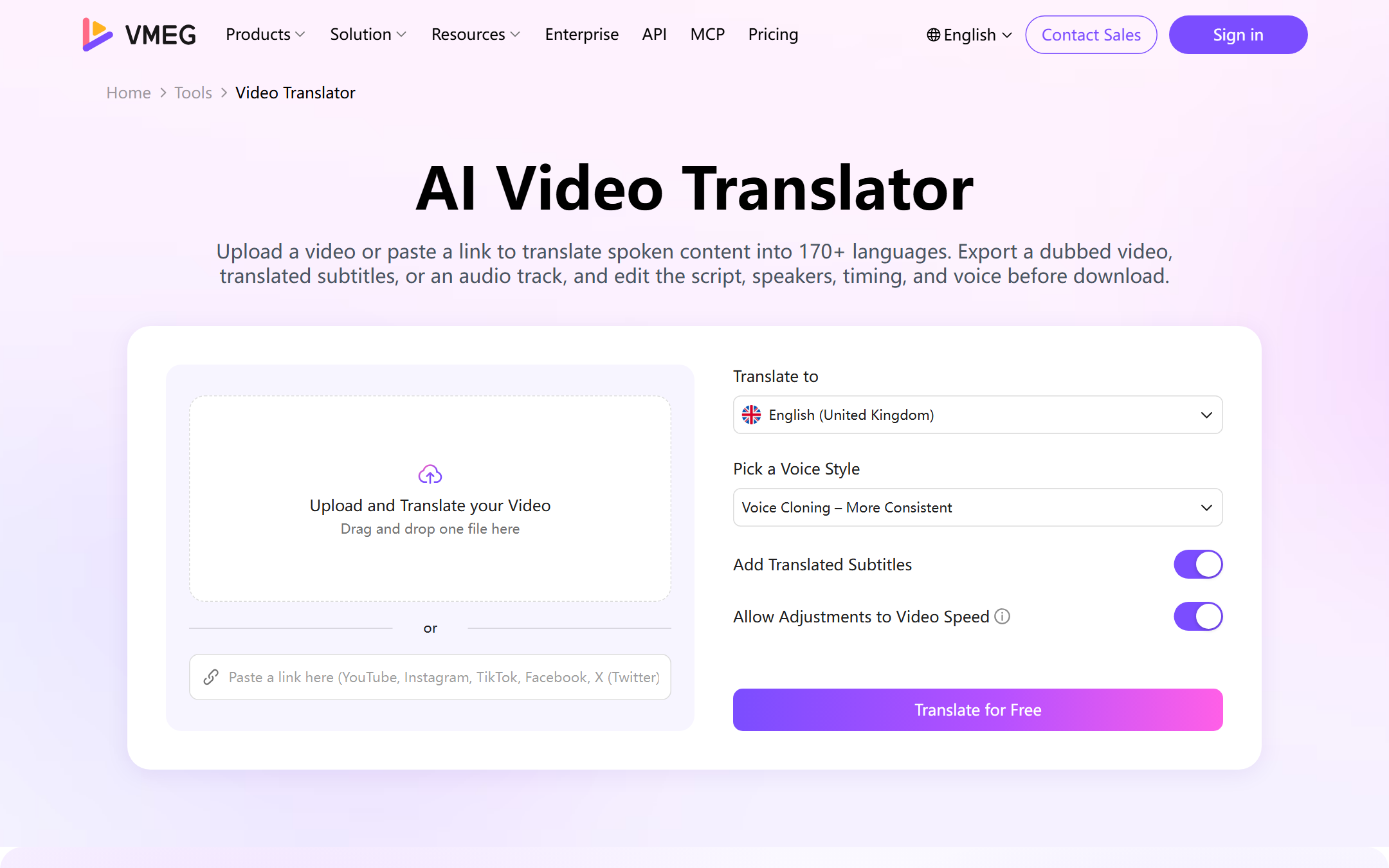
Task-specific agents match Gartner's Stage 2 framing: the product finishes an end-to-end job instead of only chatting. For multilingual video, that job covers speech translation, dubbing, subtitles, and lip sync. VMEG AI Video Translator runs that workflow as a task-specific localization agent.
Who gets value
- Companies shipping product demos, ads, or training to other regions
- Educators publishing courses for learners in more than one language
- Creators posting social or long-form video to mixed-language audiences
What the workflow covers
VMEG runs localization as an agent-style pipeline: ingest media, produce translation and voice, generate subtitles, and adjust lip sync where needed. Editors keep a human-in-the-loop path for brand wording and final checks. Batch jobs help teams process many assets without rebuilding the pipeline each time. For step detail, see the AI agent workflow for video localization.
That design sits next to goal-based and utility-based patterns: the goal (localized deliverables) stays fixed, while quality, cost, and turnaround trade off under review.
FAQs
What are the 5 main types of AI agents?
Simple reflex agents, model-based reflex agents, goal-based agents, utility-based agents, and learning agents.
What risks come with AI agents?
Privacy leaks, inaccurate outputs, weak review on sensitive content, brittle behavior when tools change, and high build or run cost without clear ROI.
When should you avoid an AI agent?
Avoid agents for high-stakes decisions without human sign-off, for data you cannot process automatically, and for environments that change faster than your eval and update cycle.
Do you need an AI agent?
Need follows the job. If people already repeat a multi-step workflow with clear inputs and outputs, a task-specific agent can cut cycle time. If each case needs unique judgment, keep a human-led process and use lighter assistants.
What is a simple example of an AI agent?
A thermostat that follows temperature rules shows a simple reflex agent. A video localization pipeline that transcribes, translates, dubs, and exports files shows a task-specific agent in content production.
Conclusion
The five core types of AI agents give a shared language for design: reflex rules, internal models, goals, utility, and learning. Hierarchical and multi-agent systems scale those ideas across larger jobs. In 2026, adoption favors agents with a bounded task and measurable output, including video localization.
If your backlog includes multilingual video, start with a task-specific localization path and keep editors in the loop for brand-critical lines. For architecture and workflow detail, continue with the localization agent guides linked above.